

What if one Manufacturing Machine could become an entire factory?
In this episode of Manufacturing Insiders, Nate Wheeler talks with Francesco Di Stefano, Co-Founder and CEO of Caracol, about how advanced 3D printing is creating a new kind of Small Batch Factory.
Small Batch Manufacturing offers a faster, more flexible way to produce custom parts on demand—without traditional tooling or large inventories. Caracol’s robotic 6+ axis 3D printing systems are enabling Small Batch Manufacturing across industries including aerospace, automotive, marine, construction, energy, and industrial tooling. Discover how a Small Batch Factory powered by a Manufacturing Machine could transform production and the future of Small Batch Manufacturing.
Interview Chapters
- 0:00 Intro
- 2:30 Large Format 6+ Axis Robotic 3D Printing
- 7:00 Enabling Global On-Demand Production
- 9:25 Self-Made Manufacturers to a Global Machine Network
- 16:50 Case Studies and the Increasing Demand for Speed
- 26:45 Addressing Operator Training and Assistance Concerns
- 34:10 Start a Business Around One Machine
Subscribe to Manufacturing Insiders for more insights on manufacturing technology, automation, and innovation. Nate Wheeler is is the owner of weCreate Web Design and Marketing, where he specializes in digital marketing and SEO for Manufacturers
Nate (00:01)
Welcome Manufacturing Insiders. Today I have Francesco Di Stefano with Caracol, and he’s from Italy. He’s got a he’s got a wonderful accent, he’s got a great personality, and he’s gonna be very enjoyable to talk to today. But unfortunately, my pronunciation of everything is not perfect. Francesco has built an amazing company, really focused on large format CNC robotic 3D printing.
Which there’s a lot of words in that, so he’s gonna break down exactly what that all means for us. they just raised forty million dollars in Series B funding, and they are global. They have representatives in most of the major countries, and they’re really helping a lot of smaller companies, machine shops, injection motors, companies like that turn their businesses into microfactories instead of just sole service offerings.
So very interesting stuff. looking forward to this conversation, Francesco.
Francesco (01:01)
Thank you, Nate, for the invitation. It’s a pleasure to be here.
Nate (01:04)
Absolutely. So before we get any further into it, just break down exactly what you guys are building and yeah, it just kind of describe to me exactly what that large format CNC robotic 3D printing is.
Francesco (01:18)
So basically what when when we started, we we saw I was I was for example working in airspace, so the modded, we saw that the manufacturing of large scale parts was still very manual. in some cases they were requiring a lot of tooling and and a lot of different processes that were taking the cost the the the process to be very long, inefficient, and and unsustainable with a lot of waste.
my co-founders, Giovanni and Paolo, decided to use the advantages of additive manufacturing, you know, 3D printing as a potential solution. But they understood that it was very small in scale. So they had the intuition of combining it with robotics, with robotic arms, to make a new technology. the la what we call what was called at the time large format additive manufacturing. So a way to leverage the
the the advantages of producing on demand with little waste with complex geometries of additive manufacturing but at a larger scale with the freedom of geometrical you know freedom of the of of robotics so it’s basically that came to as as a core to our business today we offer large format advanced manufacturing solutions through our proprietary hardware and software robotic platforms.
We start from additive manufacturing, but our technology can be integrated also with CNC ads. So not only printing, but also finishing the parts and also with scanning capabilities that will allow, for example, to control the part and you know have also a more and more automated workflow. As of today, the company started, as you said, correctly in Italy as four friends together and then launched on the market in the end of 2018 and then scaled significantly, growing 2x every year.
raised some rounds along the way and today we are a global business with two main headquarters, one in in the US, in Austin, Texas, actually, where we assemble and deliver assemble the USA machines. So we decided to come in locally to the market and we is our our fastest growing and more interesting market of expansion and of course our core market of Europe with our headquarter Italy where we have an R E center where we develop our new tech
software and hardware, and of course our production center in Barlasina, close to Milan, where we assemble and deliver all the machines for the rest of the world.
Nate (03:28)
Fascinating. So just you know, just to make the and I always strive to do this in my podcast because I always assume lowest common denominator. A lot of manufacturers I’ve talked to know a lot about exactly what they do, but they don’t understand a lot of the terminology. So in my understanding, my simplistic understanding, you are able to 3D print very large parts on any axis, you know, using digital files. Is that really what we’re talking about?
Francesco (03:57)
Let’s be pragmatic if you want some examples. Like we can print parts that I and I I apologize for my American friends if I use the meter system. It’s always you know, I never know where
Nate (04:06)
That’s all good.
Francesco (04:07)
to go. But let’s say that we start from half a meter, a meter, and we go into things that are up to 10, 15 meters in the largest configurations of our robots. So this is the scale that we handle. And the that would typically the robot would work on six axes.
So it can print at different angles, it can print non-planned geometries, it can print all the structure without the need of supports. So it basically unlocks the possibility of having complex geometries, large specialty parts. We’re talking about jigs, fixtures for aerospace industry, for aircraft panel manufacturing, modes for carbon fiber lamination, as well as we’re talking about parts for custom vans, campers, custom auto mode of applications.
functional parts or spare parts, or you can get into printing entire boats or entire, you know, components of a house, facade panels, what we call creative industries that are really getting at this technology on crazy geometries and crazy scale. So geometrical freedom and large scale parts is the two main advantages of this technology.
Nate (05:10)
Yeah, that’s awesome. And then kind of the on demand portion of it too, like you can see like an aftermarket, you know, somebody that’s making aftermarket, you know, auto parts or you know, panels for you know, an old Mustang or something like that, they could just print these parts essentially when the orders come in versus having to have, you know, a stockpile of them in the warehouse.
Francesco (05:34)
Yeah, and I think you you you got it perfectly right, Nate. I think the biggest advantage at scale of this technology is that instead of actually keep on going on enlarging our factory and having economies of scale driving where we purchase our parts and maybe also making our supply chains longer and longer in order to reduce cost, we’re getting into the we’re getting into the concept of micro factory you cited at the beginning. So
Nate (05:59)
Yes.
Francesco (06:00)
actually smaller smaller component, smaller factories more
Shops that are basically able to have a digital inventory. So a digital amount of files that they print on demand thanks to a microcluster, a microfactory cluster that allows them with a relatively small equipment to tackle the rates of production they have without the need to purchase and have logistics for it. The major mission we’re working on and we’ve built over time is we’ve built more than 30 what we call manufacturing partners all over the world.
That are our specialized partners, that are manufacturing companies in different industries, that are connected through our software and through our database, and which when we receive a request for production of parts.
We basically direct it to the closer
Nate (06:42)
Yeah.
Francesco (06:43)
manufacturing partner that produces on demand. And the beautiful thing about this concept is that we have partners that now are enabling global business models, international expansion, without actually having to open a factory. They got in contact the Japanese partner, a real example with the Mexican partner producing the same part with the same quality, only by shipping files all over and the customer getting delivered locally instead of actually
Nate (07:04)
Yep. Yep.
Francesco (07:05)
getting it delivered overseas.
Nate (07:07)
That’s awesome. Yeah, that’s it. I mean, I actually jotted that that scenario down because it was kind of like when I was reading about the sort of the connectivity and the in the software information sharing aspect of your platform. you know, in combination with the manufacturing capability, I was thinking about like, so you receive the PO and then y you know based on the connectivity which machines have have the the the time available to do the manufacturing.
And then you you know, logistically you just decide which one makes the most sense to do it, and then you send the job over to them. The owner of that machine makes a cut of that and then very interesting.
Francesco (07:45)
Yeah, for for
for exan for example, we we have a matrix. We use a matrix of evaluation. Typically because we are a global brand now and people are recognizing us for this type of of this type of technology, but people that have a project, they come to us. It doesn’t matter if they want to buy a machine or not. Also, the particular thing about us is that for five years when we started
We did not actually go about saying, Okay, we have a nice machine, we’re gonna sell it to you, like many other 3D printing examples have done. We had to create the real validation and applications for it. For five years we operated as a manufacturing company ourselves. We used ourselves our systems, we understood how to improve it, how to make it u more user friendly. So we developed it what we say from the perspective of the user.
That allows us to understand very well what’s the business model of our customer. And then when actually that distribution model came into place and the technology was ready for it, the market was ready for it, the quality the applications were qualified, we then launched this business model, in which today, when we receive a request apart, we know exactly which type of process you need. Not only with printing, but also beyond that. With finishing qualifications, we have done qualifications with OEMs. We know exactly where our partners are. So who’s the closest one to the actual
need and we map their capabilities. They might have CNC milling in-house already, they might have painting boots. So we know already which type of process they can they can offer. Through our matching system, when we get a request, that request gets matched with the with the closest and most relevant manufacturing partner in the area that has those capabilities to fulfill it. We basically engineer the recipe so we
guarantee quality control and repeatability of the parts across the network, and then the partner delivers locally the part by producing it and then finish it and deliver it to the customer. In terms of commercial engagement, that changes over time, but typically we try to be project managers because we want to guarantee the same level of repeatability and quality across the whole network.
Nate (09:42)
Yep. No, it’s a it’s a brilliant model. And I can see how it’s also an incentive to someone to buy one of your machines because you know they’re making that investment and they’re gonna have their own jobs to run on it, but you’re you’re essenti essentially s you know, supplementing their income by giving them work from the network as well.
Francesco (10:02)
I I I I I the way I see it is that our job as Cargo today is to make sure that large format additive manufacturing can print as many parts as possible into manufacturing needs. So that’s my mission, because it doesn’t matter if I sell a machine or parts in the end, if my machines are not used, I still have the same problem. So the way we can achieve that is by dividing and conquering. That’s the way I see it.
I am owner of the tech, I know I I can push the development of the tech, but without my end user, the real manufacturing companies that specialize the tech in the single application layers, we would move much slower. So the way we see it is that we generate more value as a network rather than as a company.
And that’s why we’ve been we’ve been working on it quite quite a lot. So I I totally agree with you. It it helps economically everyone. At the same time, I think it accelerates adoption of the technology, meaning it increases the cake of addressable market for this technology for us, but also for our competition too, because it accelerates also adoption of of applications. That’s the most important part.
Nate (11:06)
Yeah, absolutely. Yeah, that that’s really fascinating. So when somebody buys one of your machines, are there any promises that you can make to them as far as so I guess is is the idea of you getting a, you know, piece of work and then having that individual do that work in their machines downtime,
Is that mostly theoretical right now, or or is there a certain level that that person could expect of work from you versus from their own kind of lead generation?
Francesco (11:46)
It really depends. I don’t have a direct answer on that. It depends. There are some some some regions, for example, where we already have significant business because as a manufacturing company, we know we have significant projects ongoing and which we really need a manufacturing partner to take that. So we actually have to outsource some of that work.
And in
Nate (12:04)
Yeah.
Francesco (12:05)
some other regions in which we are discovering together. What we promise to our customers more than the actual business is the additional layers of capabilities. Because our manufacturing partners have access to our proprietary project data. They have access to a lot more training data, promotional materials, coding tools. So all these things that are shared with them facilitate their business. So in their these tools, they can use it to promote their own business and to actually
Tackle their own commercial opportunities. So the additional value that they get as a set is additional elements and capabilities in order to run their business and accelerate that. And then of course in some specific regions, it can happen that there is already a significant amount of business coming from existing projects for which we really look proactively for a manufacturing partner in that region.
Nate (12:52)
I
see. I see. Yeah, that’s very cool. So, how did you get into this? Like, what was your background?
Francesco (13:01)
My background is business actually. I’m not an engineer, even though some sometimes customers call me engineer, like but I’m not. I’m proud that I had to learn quite a lot and I’ve worked quite extensively to do get there. But I was doing business
First in Italy, then in in the UK. And before that, I was doing strategy consulting at BCG, Boston Consulting Group. There I specialized quite a lot into aerospace or the mode of industrial. I realized that PowerPoints and Excel’s were not for me. I wanted to get my hands dirty. And so I I knew these guys from university, Paolo and Giovanni, the two technical co-founders of Caracol. And together we were like they were like we think that manufacturing is the future, but it’s too small. Come see something
Nate (13:42)
Yeah.
Francesco (13:43)
we’ve been working on.
I came
Nate (13:44)
Yep.
Francesco (13:44)
to the lake, it was close to Lake Como, beautiful location, the first garage in which cargo was running. I came to the lake on a Saturday on July, expecting to go to, you know, to actually take some sun and enjoy some free time with friends. I looked at this robot, I realized that that was something I really wanted to do.
So we combined the market and the technological vision. And when I was doing my MBA at Columbia University back in beginning of end of twenty eighteen, beginning of twenty nineteen, we launched on the business. We did an acceleration program in the US, realized that the US was gonna be the future more and more for this technology. And so created this this business as we know it today by by then dedicating full time on on on on the on the mission, let’s say.
Nate (14:26)
Right. Wow. Fascinating story. Yeah. One that I can relate to too. I have no background in manufacturing, no background in engineering, but I know enough to, you know, to hold a decent conversation about it, I’d like to think. And my main business is Yeah.
Francesco (14:41)
I started like I started like that too. Decent conversation,
then more and more I when you have to deal with engineers, you really need to be strong. And so
Nate (14:48)
Right.
Francesco (14:48)
I I did a lot of training on the job, let’s say.
Nate (14:51)
Yes, yeah, same here.
Yeah, my main business is we create a marketing agency and over the years we worked more and more with manufacturers and I just really enjoyed working with them. I love learning about the processes and what they do. And you know, at this point, you know, I’ve talked to a manufacturer and you know, they’re they’re shocked at how much I understand about materials and about, you know, the processes and stuff like that. So it’s fun. It’s fun when you can match these really, really smart people, you know, in their own in their own specialty.
So so tell me a little bit about some of the use cases. You know, you mentioned aerospace automotive. is there, I guess, a typical type of business that buys one of your machines and incorporates it into their own offerings?
Francesco (15:42)
I think couple of couple of use cases. there is w we call them verticals basically. So you have the the vertical, the the more like the creative vertical that I was mentioning that is what invented the technology. That well you you can imagine parts for amusement parks, entertainment, stages, parts for construction, hotel, hospitality, wall panels, furniture, retail stores, specialty stores.
All that is basically the value proposition is there are these are manufacturing companies that they have been using traditional manufacturing techniques to serve this type of needs. One of projects, custom ones done at a significant scale, architectural scale, in which the value proposition of this technology is basically geometrical freedom scale.
and recycled materials because it can be fed with recycled material and it can actually push also sustainability. That becomes more and more important. We’re talking about, as I said, fashion, construction, and architectural firms being one main segment.
The getting more into the industrial side, the core segment of what we do is what we definance transportation. So you have custom automotive being one, as I was saying. So you know, custom parts shops, custom vehicles OEMs, specialty vehicles OEMs, for which the complexity of the shape and the scale, we’re talking about like commercial vehicles, we’re not talking about
passenger cars in this case, makes it interesting because also the volumes don’t justify balls and make it much more flex flexible in terms of in terms of business model for them and customizations. Every single piece is slightly different from the other. And then we move into maritime, where we are talking about luxury yachts, transportation of passengers.
cruise ships, ferries, in which you’re talking about very, very big projects with high level of customization, high requirements, but in which this technology really gives the best because these are very high complex parts, very long lead times, and you can produce on demand thanks to this technology. And last but not least, entire pods.
So you get to the boat hole project that right now drones, maritime drones, are becoming more and more important, U USVs, unmanned surface vessels, in which this technology is being qualified as we speak and is becoming more and more relevant to fast to enable fast deployment and you know distributed manufacturing directly on site. So that becomes a big asset because you can control it digitally and ship actually the manufacturing technology rather than shipping the part and producing on the ground.
So these are the verticals, and typically the companies we work with are either OEMs that qualify the process, they get in-house the first machines to do to study the process and you know certify the the full development of this technology. And then there are tier one and tier two suppliers that they become the major supplier of parts with these new manufacturing techniques. So typically, this is the type of industries and companies we
Nate (18:52)
Very interesting. Yeah. Okay. Yeah. And it I I yeah, that all makes sense. So it would be kind of like lower volume, very complex, very large parts that you know you y you don’t you know, you don’t set up entire manufacturing facility to do this project because that’s way too much investment. So you can have this machine that’ll just print on demand when you need
Francesco (19:15)
And imagine, you know, the big example now, there is a boom in composite industry. Why? Because lightweight performance space is an example, mar new
Nate (19:23)
Yep.
Francesco (19:24)
maritime industries, new primes that are happening all over the US, for example, also in Europe. These companies need fast deployment, they need to be fast. They cannot wait, you know, for a full manufacturing line. They are iterating and changing their product over time, and they need to produce everywhere in the world with a small footprint, but fast enough.
And so this technology becomes more and more relevant because what we are used to think as small series in the traditional manufacturing methods, let’s say automotive, now is being reshaped and completely disrupted by these new geopolitical dynamics, for which reshoring is actually making these companies more and more relevant for the industrial footprint, and they have a strong need to fulfil their growth faster and with a more flexible manufacturing structure.
This technology allows them to do that. It can be deployed, it can be scaled up, it’s modular, it can print on demand with little to no inventory, high level of possibility to customize. This makes them much more flexible to react to the market changes too.
Nate (20:21)
Yep. So when you’re when you’re in a sales process with an OEM, what are some capabilities of this technology that surprise them that maybe they didn’t know about? Maybe it could be like the materials that you can print or, you know, whatever.
Francesco (20:40)
I think speed. The first thing they’re surprised of is speed because w with 3D printing, many of those know 3D printing and they know that it’s too slow sometimes compared to injection molding you mentioned on a smaller size. What we have been developing is for example in the polymer side is based on pellets, not on filament. The deposition rates are again for the sorry, again for the metric system or like you know, European system, kgs per hour, ten kgs per hour, ten kilograms per hour. So a lot of material is pure then.
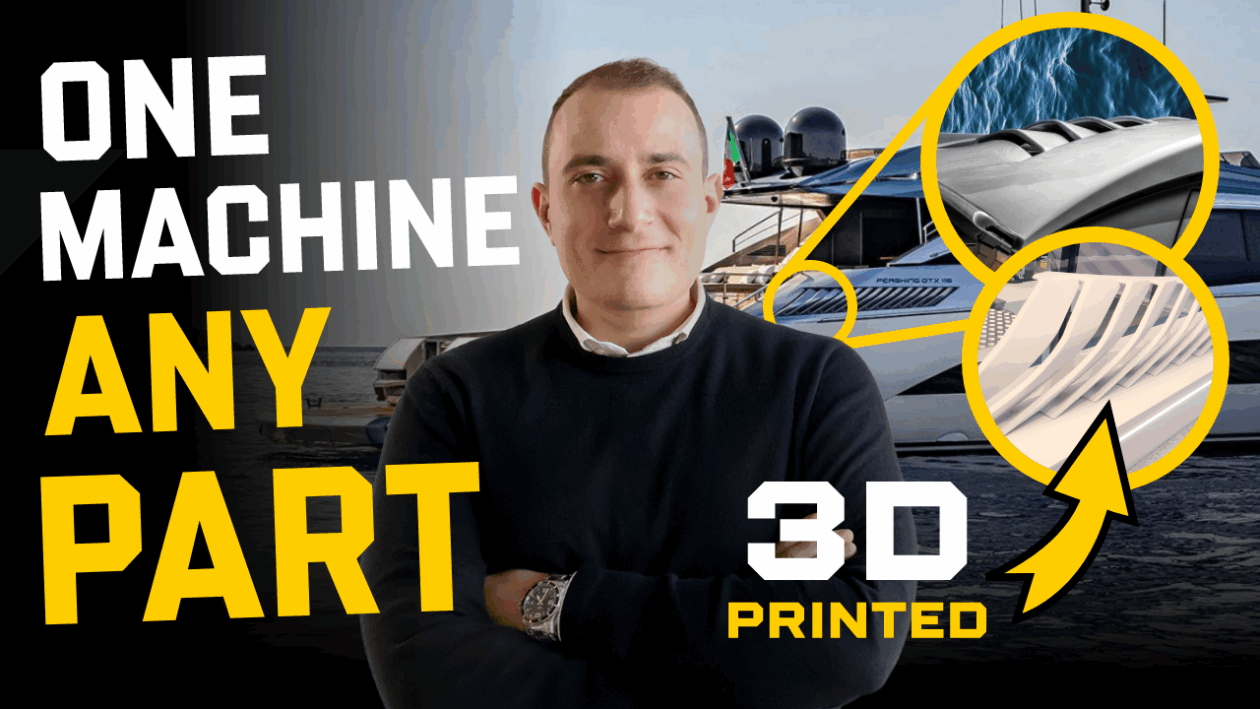
The printing times are much slower, much shorter than they thought. They’re surprised by speed. And in some cases, they are surprised by it also the geometrical freedom, the scale at which you can build these parts, and how complex these parts can be. Typical geometries, I’ll give you an example of a public case. Ferritti Group with their brands Pershing, Driva, the best of the best of luxury yachts in Europe and beyond. they have
These lateral air grids for their biggest yachts of the of of the pushing lines, in which imagine an air grid that it’s very hard to make the mold for. Like a geometry that for them is super complex to do and they need to do 10 a year. So really it’s a nightmare to get that mold done, super expensive, and everyone ev every single every single air grid though is worth it for more than 50,000. So it’s high value part for them. It’s critical. With our geometry, it’s very simple. It becomes super simple. So the shock for the customers sometimes is really
Okay, it’s it’s a new technology, so I need to go step by step. I need to make sure it works, it fulfills my criteria, my prerequisites, but at the same time they are when they get the right business case, they are completely amazed by speed and also the level of complexity of parts they can achieve thanks to that.
Nate (22:26)
Yeah, that makes a lot of sense. So you said it uses pellets, not filament?
Francesco (22:31)
Yeah, on the polymeric side. We have two major, you know, technologies. We started from from pallets, composites, polymers, and composites. so it uses it uses thermoplastic comp composite compounds, pellet based, much cheaper. The material is one fifth, one tenth of the cost compared to filament, and faster deposition rates. And the metal side it’s called ERAN AM, our platform, and then the metal side, we have a similar robotic platform that we have launched.
on the metal side for as a wire arc additive manufacturing process, typically an evolution of the of a welding process. Let’s say a 3D welding process, if for those that are not super familiar for it, that is wire fat. And there as well is much faster compared, for example, to Powder Bed Fusion, that is another you know additive manufacturing technology very well used in defense in aerospace for higher precision parts. So productivity is typically for both the machines one of the major assets.
Nate (23:28)
Okay, yeah. Yes, and that’s so that’s called what? Electri electric deposition? What
Francesco (23:35)
direct
the DED is the is the you know the the the the the definition is called direct energy deposition technology yeah it’s basically
Nate (23:43)
Energy deposition. Okay, yeah, gotcha, gotcha.
Francesco (23:45)
it’s a a a welding torch that applies some some energy directly on the on the metal and with a wire that is being welded with the wire with the with the part layer on layer
Nate (23:57)
Gotcha.
Francesco (23:58)
it gets you the the shape of the of the part
Nate (24:01)
Gotcha. Yeah, that’s fascinating to me. That’s a really, really cool process. What kind of stuff can you do with the with a DED?
Francesco (24:12)
Perfect.
Yeah, we you can do propellers for boats, spare parts. You can do repair on existing parts. You can do pressure vessels for space spacecrafts or launchers, you can do valves, gouges for the oil and gas and energy industry, you can do repair and spare parts for vehicles. I cannot share much, but we’re working with some with some of the governmental forces in order to
qualify this technology on land and sea vehicle. So spare parts is a big one. You can do components for a ship, you know, very, very large ship where everything is already welded today. When you’re putting together a cruise ship, you have an army of people with a manual welding. They’re welding parts all over the ship. Imagine if you can already pre-manufacture these components by reducing the manual welding of the operators. Today one of the major problems is that they don’t find welders.
And so all all that it becomes more and more more interesting for them.
Nate (25:12)
Is very interesting. Wow. Yeah, that opens up unlimited possibilities. Where do you feel the biggest lack in knowledge is? You know, I whenever you bring a new technology to market, it’s very typical to feel frustrated that I wish people got this. I wish people understood it. Like, what message would you send out into whom?
Francesco (25:39)
I think the first thing is is mindset. the the problem of some of these industries that they’re very manual still. So there is a lot of the these companies are are run by few very big experts of their process. They’ve been doing this for years. So the biggest message to them is that don’t be afraid. you are not becoming less relevant. We’re giving you a tool to make your job better, faster, and you’ll be it’s crucial anyways, because
The biggest lack of, I think, competences still, and that’s our job too, is in training them in understanding on how to use the machine as a complementary asset to what they have already. We’re not substituting people, we are focusing, refocusing people’s time on something that is along the process because the finishing in some cases needs to be done exactly the same. And they can focus more on programming the machine rather than applying by hand some of the material on it. So
We’re also requalifying some of those of those operators in making more higher level jobs or making more machine interaction jobs rather than manual work on the part itself. So the first message is for them, for the people that run the shops, this technology helps you. It helps you build faster and it helps you do things that are tough to do today manually. Of course, is still in some it is being adopted, but it’s still an early and young technology. It’s only 10 years old.
So we we created the market together with a couple of other companies. So we need you to keep on evolving that. We need you to engage with it. We need you to under letting us understand what we can improve to make your life easy to adopt it. Because as of today, there’s still a barrier in which we need to train extensively some of these operators to fully leverage the capabilities of the machine. It’s improving every minute that we speak at the same time, is the biggest challenge, and I think the biggest obstacle that together with our end users we’re trying to overcome.
Nate (27:34)
Right. Okay. Yeah, all that makes sense. so what is sort of the training, what’s the workup time? You know, what is kind of like to achieve like a base level of understanding of the machinery to be able to utilize it? Like what does what does that take?
Francesco (27:52)
We we do typically we do an installation time that is like three days and then two days of full training, operator training, in which we train them on how to run the machine. Of course, together with that, there is also how to design for the machine, how to program, how to use our software. So typically what we do is that you have two days full-time training in which you have a really basic understanding and then you build on top of it. I would say that if you are already skilled in using some machineries, it can be CatCam for CNC or it can be other robotic platforms.
Our interface and the way we have built, for example, all the software is to make it as user-friendly as possible. You don’t need specific robotic skills to run our machine, but you need to understand the logic of how to program for this type of process and this type of machine. So I would say two to five days, it’s enough training to have to run. And then you need to build your experience layer. The more you run projects, the more you see different geometries, the more you understand and run materials, the more you build
different approaches that allow you to be more productive, to increase your ROI. So the basic training gets you to use it and utilize the machine and deliver what you were supposed to. Then the experience gets you, and we say that typically the real ramp-up time is where we try to be as close as possible to our customers, is the first six months that they use this machine. Because they start from understanding to operating to optimizing more and more step by step their learning curve and also their economics in running the machine.
And that’s why, for example, in Caracol, we decided to go, not as many European companies do. We’re gonna open our US entity that is gonna be full of commercial people. No, our US entity is a is a is a manufacturing shop with service engineers that are close to our end users that work side by side with our customers, that they reply within 24 hours and they run jobs together with you. Support is our first lever. And why? Because on the one hand, we are the user.
We still run our machines. We have those five years of experience. We still do that. We still run that manufacturing central hub in in Italy to still be up to date on which are the major challenges and the major things that we can unlock for our network. And by doing that, we also have an advantage level of service we give to our customers because I’m gonna help you service your machine from the user perspective. I’m gonna help you on your parts rather than on running your machine. You will be running your machine thanks to my advice, but I focus on your project first and then.
Together we will run the the process. I think that’s a big of value added. It’s
Nate (30:20)
Big time.
Francesco (30:22)
it’s expensive, it’s an investment, it’s not easy to run globally, but that’s the core of our mission. We want to enable the production of parts. How? Through very good technology, good support, and new and new investment in in unlocking new applications.
Nate (30:37)
Yep. No, that’s huge. That’s such a big value add to actually have the assistance on the ground. would you say that the the baseline level of qualification, like if somebody was gonna buy this machine, d they should probably have CNT programming experience? what what do you need from somebody?
Francesco (30:58)
It really depends,
Nate, because I’ve seen customers buying this as a first equipment in their life and being very successful to it because they had a clean, you know, white page. we we are strong on training because as I said, as if you are a first user, you you give tips and tricks that go beyond how to use the machine. So
Nate (31:17)
Yep.
Francesco (31:17)
some cases you it really like having a basic understanding, maybe I would say there are three categories of users. The ones that have been using 3D printing before.
And so they jump into this. They understand the logic of how a slicing software works, a machine works, but they need to understand that this is way more flexible than a normal printer because it has three axis more, for example. It has the possibility to be larger. So they need to they are a bit stuck into traditional 3D printing and they don’t understand fully the advantages and limitations of this, but they start from a good base.
Then there is a second, and it’s good. It’s good enough because we can train them through experience. We show them and they build the gap that they have. There is the ideal users, I think they have had already cut-cam experiences with other types of tools. And that’s pretty, pretty interesting because they know robotics in some cases, or they know you know how to program a five access country. That gives them the understanding of how I need to program for a machine, that I need to set up a machine, that I need to manage post processing mode apart. So they have manufacturing.
Or even I would say a completely green operator that, however, is keen to learn and knows the basics of manufacturing, you know, as a as a as a logic, have seen that in the past. We can build from there. It would take a bit more at the beginning, but then it’s probably gonna be a much more verticalized and specialized operator because that’s the main experience he has been training on.
Nate (32:44)
I see. Okay. So do you see people completely building a business around this one machine?
Francesco (32:51)
This is the the the thing I’m the proudest of. There are two things that drives me at work. One is seeing my employees and my my partners growing and taking on new challenges. And we’re all very young in the company and you learn fast, there’s a lot of responsibility, but you grow a lot. But the second, the most important one the proud of, we see complete spin-offs of existing companies starting with twelve machines in it, equipped by us.
Or companies and entrepreneurs that they get to meet us, they had wanted to add a business idea, producing a you know, chair or like a line of products and e-commerce globally, and they buy as a first manufacturing technology ours and they start a business from scratch. I’ve seen that happening in Mexico, in in in Japan, in the US, in Italy. And this is the thing that makes me the proudest of because it means that we’re creating value. In the end, I don’t care how many machines we sell.
If there are people that are making good money and new opportunities thanks to these machines and thanks to our support, it means that there is value for it. Otherwise they would be maybe buying a couple of machines here and there, but that would stop. And many of our customers are scaling fleets. And this is probably the thing that I’ve always wanted to see. And more and more I think it’s gonna measure how good we are doing in terms of of supporting our customers.
Nate (34:10)
Yeah, well that’s really cool. You know, it’s kinda I like I’m thinking like marketing marketing track right now, but you know, if you have ten, fifteen, twenty of those use cases where somebody built a business completely around the machine, that’s such a great way to build an understanding of what they’re capable of.
And then you have somebody new coming in that says, hey, I want to build this you know, whatever, this this custom gaming chair and build a business around that. How do you build, how do you manufacture a custom gaming chair? Well, guess what? Caracol has a case study on their website about building a gaming chair with their machine. They’re like, so I don’t need to get, you know, overseas manufacturing and have 50 different suppliers. I can buy this one machine and build my entire product.
Francesco (34:55)
And I can work with a manufacturing before. So I have a local manufacturing partner in New Jersey, just saying a state where we have a very strong partner that started from scratch and thanks to our machine now is scaling, just distoled the second and scaling with the third. I wanna mention them because I think they deserve this visibility. It’s called Decibel Made. great guys, young guys from that started their business with normal 3D printing, but that they really took off thanks to large format, thanks to their vision. You can work with them.
To the pre phase of your business together with them. They help you in the development. You don’t need to buy overseas. Get your product ready. And when your product is ready, maybe you can also scale your fruit and maybe have a specific manufacturing needs with this machine to actually fulfill that. Everything in the USA with local people, with a local ecosystem, with a local support of companies that are investing locally and helping you every step of the way. That’s the way we want to build our ecosystem. We we talk we talk about community and ecosystem.
Nate (35:46)
Amazing. Amazing. Yeah, I love it.
Francesco (35:50)
This is the way we want to work. Everywhere we go.
It doesn’t matter if we started from Italy. Whatever we get into a country, we need to create a a a community and an ecosystem. We need a manufacturing partner, we need local support, we need an ecosystem a a technological ecosystem that helps the customer run and tackle all the challenges of producing his products.
Nate (36:10)
Amazing.
Well, very cool. I really enjoyed our conversation. It’s fascinating to learn about this new technology, and I completely agree with you that additive manufacturing is the future of manufacturing. And the micro factory concept is r just super vital to sort of the US goals of reshoring, because you’re not gonna be able to start up, you know, hundreds and hundreds of new types of factories here, but having the ability to do these things on a small scale, I think, could solve a lot of those issues.
Plus the workforce issues. I mean that’s that’s another big value.
Francesco (36:42)
And the more
broadcast issue and time. The world is moving faster and faster. Supply chains are changing faster and faster. How can you be competitive over time? You need to be flexible. You need to react fast. You need to deploy fast factories. And I think what’s happening on defense right now explains that very well. We need to build
Nate (37:01)
Yes.
Francesco (37:02)
manufacturing capabilities in times that are a fraction of what we used to in the past. How do we do it? New manufacturing techniques. And that’s
Nate (37:09)
Yep.
Francesco (37:09)
what we’ll try to address.
Nate (37:11)
Awesome. Well, Francesco, I really enjoyed it today. thanks a lot for joining all the way from Italy. hopefully I can come visit you soon over there. Never been to Italy, I’d love to. yes, absolutely.
Francesco (37:23)
We give you a good excuse. Thank you for inviting me, Nate. It was great to chat to you.
Nate (37:28)
Awesome. All right, thank you. All right, good job. That was very good.
it usually takes about two weeks or so to you know, get things cut, edited and everything like that. if you could just have which I can send her an email. I don’t think I’ve got a headshot from you yet, but we’ll use that for the YouTube thumbnail. but yeah
Francesco (37:49)
Feel free to send me everything you
need, I’ll have marketing sending you what you need.
Nate (37:53)
Okay, sounds great. Awesome. Yeah, and just one side note, you know, it’s no pressure, but I’m always remiss if I don’t say anything about it. we have a lot of experienced marketing manufacturers. If you need some help and you’d like to get some digital expertise, you know, even just a quick look at your site and give you some recommendations, happy to do that.
Francesco (38:14)
I appreciate that, Nate. I think when you when you send me that email, I’ll get you in contact with the with Violeta and Eleetra, our our lead for the marketing team. I think they’ll be happy to have a chat with you to understand how what you do and how you could support us eventually. It’s worth exploring.
Nate (38:29)
Yeah.
Yeah, absolutely. Cool. All right. Well yeah, have a good
Francesco (38:32)
Cool man. I’m sorry if I reschedule, I hope it was worth it though.
Nate (38:36)
No, it’s all good. Yeah. I think it turned out great. All right. You two. Bye-bye.
Francesco (38:39)
Thank you very much. Have a good one. Bye
bye.