


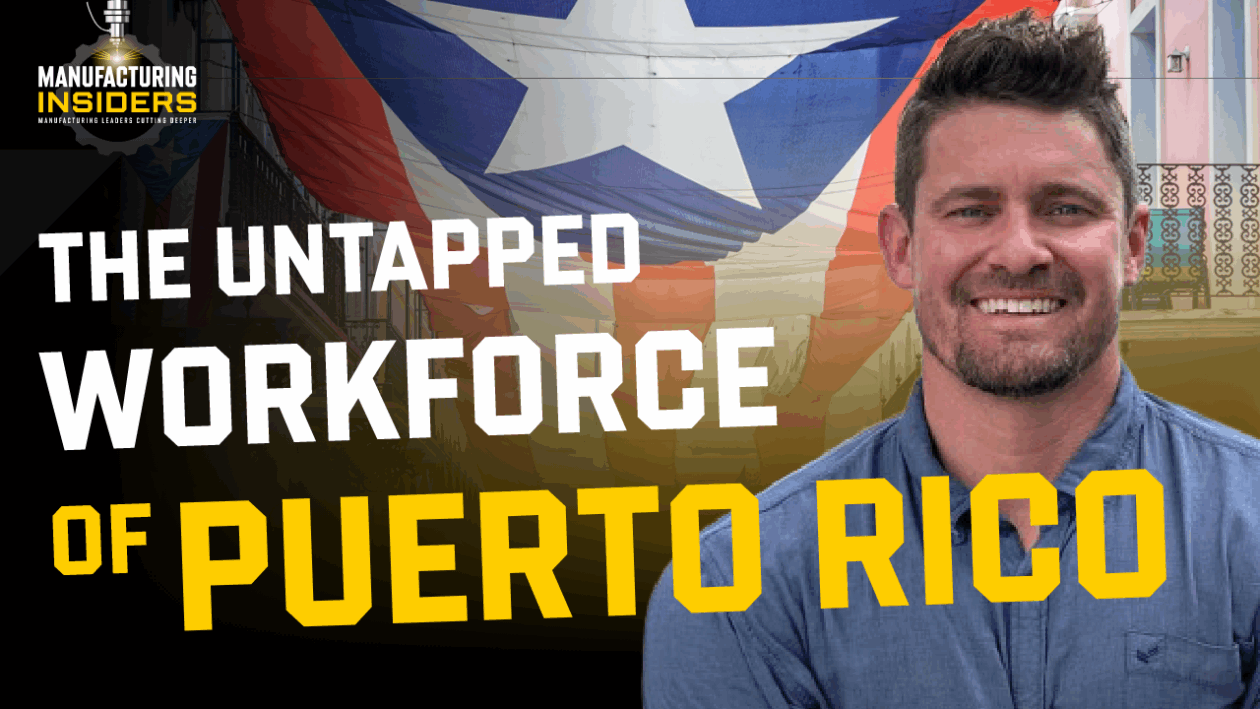
This will change the way you think about importing workers.
It’s no secret that manufacturers across many industries in the United States are struggling to find workers. But what if a significant workforce is already in the United States? In this episode of Manufacturing Insiders, Nate Wheeler sits down with Clay Martin, founder of Isla Talent Recruiting, to explore an unconventional approach to the manufacturing workforce shortage: recruiting workers from Puerto Rico. Because Puerto Rico is a U.S. territory, manufacturers can access this workforce without many of the visa and immigration complications associated with recruiting internationally. Clay explains how he connects manufacturers with workers looking for better opportunities, why many are willing to relocate, and how this approach can help companies break out of the revolving door of recruiting, hiring, and losing employees. But this isn’t a simple solution, and Clay is upfront about the challenges. Housing and transportation have to be addressed. Language barriers can require translation tools, bilingual employees, or other support. Manufacturers need to understand that recruiting workers from Puerto Rico is about more than filling a position — it requires companies to think differently about how they support and retain their workforce.
Clay also shares how he evaluates manufacturers before working with them, why company culture and how employees are treated matter, and why he has turned down potential clients who weren’t willing to take the “human aspect” of recruiting seriously. For manufacturers struggling with workforce shortages, this conversation offers a different question: What if the workforce you’re looking for isn’t overseas — but already belongs to America?
Interview Chapters
- 0:00 Intro
- 1:15 Clay’s Mentorship Passion: Peace Corps to Business Owner
- 7:35 The Red Tape of the /H2-B Program
- 9:15 How He is Solving The Revolving Door
- 13:45 Walking Through the Process as a Business Owner
- 17:45 Many Ways to Address the Language Barrier
- 20:45 Success Relies on You: Good Business Practices
- 29:00 The Human Aspect of Good Business Practices
- 34:30 The Scale of Recruitment Many Aren’t Ready For
- 35:45 Final Questions
If you find value in this episode, make sure to like, subscribe, and follow along for more conversations like this!
Visit their Website! https://www.recruitingpuertorico.com/
Nate Wheeler is the owner of weCreate Web Design & Marketing, a nationally recognized marketing agency that helps manufacturers grow, save money, and become more efficient.
Reach out to us below. https://www.wecreate.com/contact
Nate (00:01)
Manufacturing insiders. Today I have Clay Martin with me. He is helping manufacturers and other kind of blue-collar jobs solve workforce issues through sort of an unusual way that I never thought of before. he actually helps companies recruit from Puerto Rico, which takes out a lot of the you know red tape and complications with overseas workers. So you’re kind of getting the benefits of sort of a l a low wage scenario, you know, people that are really hungry for higher wage jobs, that will be willing to move to the US for a better life and you don’t have a lot of the visa-related complications. So very cool stuff. Clay has a very interesting story as well. He kind of came from the the jungles in you know, working with a Peace Corps, no electricity, work you know, living with indigenous people to starting a really successful business out of his parents’ basement. Now he’s just thriving. So welcome to Manufacturing Insiders, Clay.
Clay (01:02)
thanks for having me, Nate. I appreciate it. and I appreciate you taking my LinkedIn request and message. I I send a lot of those out, get a lot of not a lot of responses. So thank you for your response.
Nate (01:13)
Yeah, absolutely. Yeah, and you know, the way that I look at it is I typically we like to interview manufacturing leaders, guys that are actually doing the manufacturing work, but sometimes something comes across my desk and it’s like, This is a really you know, this is a really viable topic that manufacturers should be interested in, especially with so many of them struggling to kinda to, you know, fill those positions. So
Clay (01:36)
Yeah.
Nate (01:37)
so tell me tell me a little bit about yourself. gave just little preview of your your background, but tell me a little bit more about it.
Clay (01:43)
Yeah, so I’m from Cincinnati, Ohio. I I became pretty passionate about Spanish from a very young age. that eventually led me to studying abroad, kept studying Spanish. That led me into the Peace Corps. Peace Corps was the best and most challenging experience in my life at the same time. I lived in Ecuador and Panama for a total of four years with indigenous groups, like you said, and did some amazing projects, you know, reforestation, gardening and a lot of tourism projects like community tourism. So it was a really special time in my life. I I take a lot of pride in it. I know you’ve you’ve served the country and you understand what what that’s like. I so yeah Yeah. Yeah.
Nate (02:27)
In in the in the not peace core.
Clay (02:33)
so yeah it’s it’s it’s it’s great. It was a really great experience and that, you know I learned a lot as you know as a young man in the Peace Corps about human relationships and just creative ways, you know. I feel like my creative juices started mixing together when I was in the Peace Corps because you have to be creative to try to be successful there. And you also have to be a understanding that it’s okay to fail. You know, I failed all the time. And so I feel like that’s led me into being an entrepreneur and my time in the Peace Corps. So I eventually started a recruiting company, Isla Talent, recruiting from Puerto Rico. I live in Denver, Colorado. I love mountain biking, all the outdoor stuff. And I’m also in the Big Brother program. So that’s a little bit about me.
Nate (03:13)
That’s very cool. Yeah. And now I I was just talking with somebody the other day that was in another sort of mentoring program, not the big brother, and so I’m I’m having trouble remembering if we talk directly about that or
Clay (03:30)
I’m not sure, maybe. So it could have been me. I actually I was in the Big Brother program for a very long time and then I did I decided to switch in Denver to a program called Denver Kids. And so
Nate (03:44)
Okay.
Clay (03:45)
it’s a it’s a smaller version of the Big Brother program and I recently just just did that. So it’s it’s it’s a local program, a local mentor program.
Nate (03:54)
Okay. No, I think that’s great. I was actually a big brother for close to maybe seven years.
Clay (04:02)
really? I didn’t know that. Cool.
Nate (04:03)
Yeah, yeah. So I guess we didn’t talk about it. So no, I I guess I didn’t know that. No, I think it’s a great it’s a great program and I mean a lot of these kids need a good male role model in their life and there’s a lot of them that are gonna grow up without it, without programs like that. So I think it’s so awesome to be able to give back to the community in that way and it’s something that’s so needed. I mean, there’s a lot of research to support the idea that i if a if
Clay (04:28)
Yeah, I did.
Nate (04:29)
a male has a strong male figure in his life growing up, he’s gonna turn out to be a better
Clay (04:33)
right.
Nate (04:34)
you know just asset to society so awesome
Clay (04:37)
Yep. Yeah. Yeah. It’s been great. I mean, my my little brother from from Cincinnati, his name’s Rico, and I officially stopped being, you know, I stopped being in the program when I moved to Denver from Cincinnati about eight years ago, but we kept in touch and you know he’s super close my parents though. And he actually just graduated high school and he’s on his way to college and I flew him out here to Denver, first time on an airplane.
Nate (05:03)
Yeah.
Clay (05:03)
And he he came out to Denver and we had an incredible time. So that was really special. And yeah, you’re right. I mean, it’s an incredible program. Mentorship is great. It’s definitely a passion of mine.
Nate (05:13)
Very good. Yeah, and I mean I think that kind of plays into, you know, what you’re really doing. You know, I think a lot of recruiters might see their job as as, you know, just you know, kind of a you’re you’re making profit off of placing people. And I think you have some passion in actually giving these people a better life and helping them achieve their goals at the same time as helping, you know, a manufacturer, for example, you know, fulfill their goals.
Clay (05:41)
Yeah, yeah, I appreciate you recognizing that. It’s it’s definitely true. I mean, I do I do charge a fee for my services. but I like to keep in touch with my recruits, even well past r you know, getting my commission and kind of after that relationship with that client’s kind of dissolved a little bit. I mean, I was chatting with a guy today that I recruited six months ago and he’s like, Clay, thanks so much. I’m still doing this job. I’m really happy. I can’t wait to come back next year. Like, I’m saving, saving money, about to buy a car and it’s it’s cool. I mean, it’s great. I love keeping in touch with these guys. Whenever I go back to Puerto Rico, if I can, you know, we we’ll grab a coffee or grab lunch and it’s it’s really special.
Nate (06:21)
Yep. Awesome. So like let’s talk about some of the you know, just the logistical details of how it works and like what the benefits are. So I mean, traditionally if you were to have a what a H1B,
Clay (06:36)
H2B.
Nate (06:37)
H2B, you know, from some other country that’s not affiliated with you know directly with the US or part of our territories like Puerto Rico, how does it work? What are the problems that occur there?
Clay (06:48)
So I mean, the the H2B program, I mean, when it works, it works, but it’s it’s it’s a ton of red tape. So there’s a lottery system, every, you know, all these seasonal companies out there, jobs that are seasonal, they they want these H2B visa workers. Well, it’s tough because you know, there’s there’s legal fees, there’s a lottery. You can apply for the program and then expect to get 50 workers. In March, and then they’re like, sorry, you’re not gonna get them until May. And then May turns into June, and then June turns into maybe no one’s coming. So it’s it’s a little unreliable. When the workers
Nate (07:24)
Right.
Clay (07:24)
do when the workers do get there, it’s great. I mean, I always like to go on record and say this as an American citizen. I I believe in that program. I think we do need it, but I wouldn’t put all my eggs in one basket. I believe in recruiting US citizens when we can, and and people that are already here, and that’s why I wanted to provide. My services. but yeah, that that that program is there’s just a ton of red tape and and those workers are tied to that one job. That’s the biggest difference. Like they have a visa for that specific company.
Nate (07:58)
Okay. I know in a lot of cases manufacturers literally just can’t find someone to fill some of these positions, whether it’s, you know, you know, sorting inventory, quality inspections, whatever you know, whatever some some of the I guess lower skilled level jobs in the facility might be. And You know, so I can see, you know, hiring from Puerto Rico being a really viable option for a scenario like that. Curious, is there some cost savings there involved as well?
Clay (08:29)
So, I mean, we do want the the workforce that we recruit, you know, we do want them to get paid a fair wage of what people are getting paid locally. That’s that’s super important. I think the cost savings comes with the retention and the instead of having that revolving door that all recruiters and people in HR remember and understand are empathetic to, it’s like, you know, it’s so hard to find workers and you’re doing all these you’re it spending resources and ads and job fairs and sometimes coming up with nothing. And you know, my, you know, my kind of my famous line is I can recruit 10 workers within two weeks for you. I could
Nate (09:07)
Right.
Clay (09:08)
recruit 50 workers within two to four weeks. And so it’s I take care of that those headaches for for recruiters and HR managers.
Nate (09:16)
Okay. One of the other big Issues that manufacturers are having today with employment is even if they are successful in placing people in these roles, a lot of times they’re not happy with the work eth ethic or the punctuality of those individuals. And you know, just a lot of issues like that. I was wondering if you like had any broad stroke observations about, you know, Puerto Ricans and their work ethic and how they operate versus maybe what manufacturers are seeing from local employees.
Clay (09:51)
Yeah, I mean, I I’ve heard great, I have great feedback from my clients. I’m not gonna say it’s perfect. I mean, island culture is a real thing, but you know, part of the preparation is when the my workforce is coming over, the workforce that I’m sourcing, I talk to them ahead of time and I’m like, these are the expectations. This is what you have to do. And then when they arrive and they’re getting getting an orientation from my clients, I make sure the clients kind of go through all the expectations and attendance and all that kind of stuff. And you know, someone for the most part, someone that’s that’s relocating and and flying across an ocean and and leaving their family to come work, they’re gonna be dedicated and they’re gonna show up on time and and I’m not gonna say it’s perfect, but for the most part it it works out really well.
Nate (10:37)
They they have a little more investment in it and a little less optionality, I guess.
Clay (10:43)
Hundred percent. Yeah. And that’s the thing because a lot of these workers come over and they’re they don’t they’re tr relying on someone like myself for a job. You know, they don’t they don’t have the a language ability or sometimes the confidence or the know how to just say, I’m gonna go find another job elsewhere. And a big part of that is is the housing. You know, my I require all my clients, which is the companies that I work with and support, I require them to provide housing for these workers. And that’s something that you’re gonna have to do. Whether you whatever whether you loot excuse me, whether you utilize a company like myself or try to do this on your own, the workforce is gonna need the workforce in Puerto Rico is gonna need some assistance and getting set up with housing. And that’s what keeps these workers kind of tied to the job. They they can’t just quit and go down the road typically and afford an apartment on their own and a deposit and furniture. So that’s kind
Nate (11:34)
Right.
Clay (11:35)
of what what holds them together.
Nate (11:37)
Okay, okay. Do you see employers kind of doing like you know, let’s say I I needed four employees. Would it be unusual or not right to get a four bedroom apartment and put all four of them in one apartment? Is that a normal thing to do?
Clay (11:57)
Yeah, yeah, that’s a great question. I mean, I I think two two people per bedroom is kind of the standard. That’s kind of that’s accepted. That’s a lot of the guys and girl the the men and women that come over, they know it’s it’s typically two people to a bedroom because they’re getting that benefit. And so I let them know that ahead of time. there are a few caveats with with you know, we don’t like to mix men and women in the same apartments. So if there’s a unique housing situation. I’ll have the women or the women staying in this part, the men in this part, or sometimes I get c I’ll recruit couples that can live together, but it’s all kind of on a case by case basis.
Nate (12:35)
I see. Okay. so I guess kind of walk me through the the scenario from start to finish where I’m the employer. I need to fill, you know, 10, 20 roles in my company. what what are my kind of first steps? So I have a conversation with you, I say, here’s kind of what I’m looking for. and then, you know, how do I get them here? How do I plan schedules? How do I know when they’re gonna be here?
Clay (13:04)
Yeah.
Nate (13:05)
you know, how do I look for w you know, what kind of housing am I looking for? Like just kinda talk me through all those details.
Clay (13:11)
Yeah, absolutely. So I actually had a conversation with a manufacturing company today and they they kind of asked me that exact same question. Well, this is gonna work out. How does it go from here? So as always, it starts with a discovery call. You know, we hop on hop on a call, I kind of tell them the expectations, I learn about the company, I find out if I wanna wanna collaborate with the company based on if they’re a good cultural fit. but most importantly, are their benefits gonna be attractive enough to attract talent? From Puerto Rico. And so I’ve been doing this long enough that I know, you know, I kind of have an idea in my mind what what you should be paid in certain states, what the benefits should look like if there’s overtime, how much are you charging for housing, all these kind of things. So after that phone call, the biggest thing is that the company needs to find out if they can identify housing. Some of these, some of the manufacturing companies I work with are in cities like Cleveland and there’s a lot, and then some are in the middle of Iowa, you know, or middle of Wisconsin and in small towns where there’s not as much housing. And sometimes that’s the reason that doesn’t work out. So once they identify the housing, then then we hop on another call and I kind of make sure that they understand all the expectations, everything that’s involved, the transportation, making sure these workers have a way to get to and from work, to the grocery store. Most of my clients provide some type of vehicle for the workers to utilize. and of course of course there’s like a, you know. I have documents in English and Spanish that that outline rules for the housing and for the vehicle. So it’s a pretty quick process. I mean, the and then the last thing that the work after the housing is identified, the the clients need to create a job offer and a job description. And that needs to entail as many things as possible to avoid any misunderstandings. So how many hours are working? What hours are the day? Pretty much the standard stuff you would think of. But the the additional things to that that aren’t normal when you’re hiring a local workforce is you’re providing the housing, you’re providing the transportation. So, you know, they need to include things like how much are they charging? How often are they charging? What does the housing include? What are the rules? What are the expectations? So all that is in this job offer and job description. and then, you know, it’s a pretty quick turnaround. Some of my clients call me and they give me a two month notice, and some call me and give me a two week notice. So I get pictures of the operation. So I want to see this manufacturing facility. I want to I want the workers to be able to visualize and see exactly what they’re getting into. And you know, I think that should be part of any hiring practice, right? Whether you’re coming from Puerto Rico or you’re local person, you should be able to visualize what the environment’s gonna be like. so I share all this information with the workforce. I do all the recruiting, I do their background checks, I collect their resumes, do the interviews. And once I identify the the group of people, let’s call it 10, then I help the logistics in figuring out flight itineraries and then the companies buy their flights from Puerto Rico and I kind of help assist with that logistical process.
Nate (16:19)
I see. I see. Okay. one of the biggest barriers, like i you know, just kind of putting myself in that manufacturer shoes, that I would sit see is if I don’t have Spanish speakers on staff, like how could I make that work? Is it possible to make that work?
Clay (16:40)
I definitely think it’s possible. I mean, I offer customized like translation services and all that kind of stuff, but people can there’s ways to get around it. I mean, most people that you know, if I recruit a group of 10, there’s gonna be at least a few people that are gonna speak English that can help translate. on the client side, I mean, there’s I’ve seen clients use translation apps that work really well. They get they get material translated ahead of time. I’ve had companies hire a local Spanish teacher that works part time or someone that’s retired that speaks Spanish that kind of comes in three days a week and just translates for meetings. So it’s definitely doable. And with tra with technology now, I mean, technology and translation apps, it’s very possible. And
Nate (17:26)
Gotcha. Okay. do you find a like a lot of willingness or desire to to learn English with with these workers once they get here?
Clay (17:38)
Yeah, absolutely. I mean, it Puerto Rico is an island driven by tourism. So people that don’t know English, you know, they wanna they do wanna pick it up if they do decide to go back to Puerto Rico. And if they decide to stay, they want to learn the language. So and it’s and peep they pick it up pretty quick. That’s what I’ve noticed because because it is a US territory, you know, and because there are a lot of English speaking people that spend time in Puerto Rico. But a lot of entertainment that everyone watches in Puerto Rico, or the music, it’s in English, you know, the movies are in English. So they have a great bass. And I feel like a lot of them, when they come to the States, they pick it up pretty fast. And that’s what they tell me. I’ll say, Hey, what’s your English level? And they’re like, Well, I understand more than I can speak, but once I get there, I start speaking because I’m surrounded by it. You’re immersed.
Nate (18:28)
Right, right. Yeah, and a reason why I ask is like I’ve, I encounter a lot of people, especially like, you know, we went down to Nashville and all of the Uber drivers are foreigners that don’t speak any English. And I just found it found it really unusual because I was like, why aren’t these people saying hi or anything like that when we get in the car? They don’t say a word to you the entire time from pickup to drop off. I just thought it was kind strange. And then I realized they don’t speak any English whatsoever. And it just kinda blew my mind like I went to Costa Rica this past summer and in even being there for ten days, I was like trying as hard as I could to start to retain some phrases and to know what I was and I’m like, how could you be in a culture immersed in another language and just be like, Nope, I have no interest? It’s very strange.
Clay (19:15)
Yeah. Yeah, yeah, yeah. Yeah. Yeah. I mean it’s hard. Learning the language is hard. I mean, I I if I moved somewhere, I would want to pick up the language from there, but you know, the older you get, the harder it is.
Nate (19:28)
Right. Yeah. Yeah, for sure. Do you have like any sort of like average retention numbers for the for the placements you do?
Clay (19:37)
Yeah, I mean, it’s a lot of it really does depend on the client. I mean, a lot of it depends on how how how well the benefits are, the work environment, but I typically like to say around like seventy percent success rate. And
Nate (19:52)
Okay. Okay. Yeah, that’s good.
Clay (19:55)
and when I say s 70% success rate, what I mean by that is, you know, at the end of the year is that client of mine saying it was worth doing this. That’s that’s kind of the the number in the reasoning because you know there is attrition you know people do quit people do get fired and i’m super transparent about that you know that’s that’s one of the one of the things I take a lot of pride in a lot of my clients tell me they say Clay we appreciate how honest you were about everything because I try to prepare my clients to understand the good the bad and the ugly and you know I always use the example that that utilizing my service is or any service like mine, it’s an investment and investments come with risks. And it’s it’s sort of like the stock market. So, you know, the stock market’s the long game. So if you if you were if you recruit people from Puerto Rico through a service like mine, you know, it the first three months might be a little tough, but the longer you stay with it, it’s gonna you’re gonna learn more and it’s gonna compound and it’s gonna be successful in the end, you know. But you’re
Nate (20:55)
Right.
Clay (20:56)
gonna take a few steps forward and take a few steps back. A few steps forward, one step back. But if you stick with it, it’s gonna be worth it in the long run. And that’s why. I try to coach all my clients just on being patient and flexible. Patient and flexible and understanding. You know, there’s a human aspect to this. You know, you’re recruiting job seekers from a very far away place, from a different culture, and it’s gonna it’s gonna be tough. But at the end of the day, like it’s gonna be good for everyone.
Nate (21:22)
Mm-hmm. Yeah, for sure. Well let’s talk about the risk. So worst case scenario, I, I, I, I feel like the more people that you a company would recruit at once, the less their risk is because you’re not gonna lose everybody. You might lose some. Whereas if you place two people with a company, you could very l easily have paid for transportation for them to come to po to the US, paid for their housing, and then they’re like, they don’t show up to work. so that would be like worst case scenario. So I guess tell me like what is the cost of worst case scenario and you what is the remedy?
Clay (22:01)
So, I mean, worst case scenario is everyone that you recruit quits. I mean, the can’t the chances of that happening are very slim. I mean, not everyone. and I have a replacement policy. So I I recruit anyone that quits or gets fired within the first 45 days, I replace them at no charge. But be being a small business, being the business owner, I work on a case by case basis and I want to do what’s right to fix any relationship. So I do everything I can to fix the worst case scenarios that happen. Right. And so I say this all the time to my clients, as long as you treat me well and and pay your invoices on time and treat your employees well, I’m gonna do the same back for back to you and I’m gonna go, you know, go the extra mile to make things right. And so I I just think that’s good business in general. I mean, I was listening to a podcast the other day that I listened to. I don’t if you listen to how I built this, but really good podcast about how businesses get started, et cetera. And there’s a someone that, is a food manufacturing company and they talk about they they talk about working with Trader Joe’s and they’re we love working with Trader Joe’s because they pay their invoices on time. So we made sure to kind of go the extra mile. And I just that stuck with me. You know, it’s like you want to work with good companies. You want to work with you want to partner with companies that have the same values as you and when there are major value shifts, like it’s tough. You know, it’s a really tough thing. So I don’t know if I don’t I don’t know if you’ve experienced that in your life, but I have and it’s it’s when things don’t work out it’s tough, but it’s it’s better to stick to your values and walk away when you have to.
Nate (23:39)
Yep. Yeah, I I absolutely agree. And I I certainly experienced the you know, the larger the company is, the the less they tend to pay their bills on the more money they make, the less they tend to pay their bills on time. Which is kind of crazy. And it’s crazy to me ’cause it’s like I’m always thinking you’re gonna have to pay the bill one way or another. So like who cares if you pay it now or on your ninety days net bull crap or whatever you you you want to do, like you’re eventually enough to pay it, just pay it. that’s the way
Clay (24:12)
Yeah, right.
Nate (24:13)
I do it. Like I’d rather just get it taken care of than you know everybody’s happy.
Clay (24:17)
Yeah.
Nate (24:20)
so yeah and then I also imagine that even in that worst case scenario you you you place two employees, the employer rented an apartment, they furnished it, you know, got all set up for it and then these employees quit you can place people pretty quickly. So it’s not
Clay (24:35)
Yep.
Nate (24:35)
like that apartment is just gonna stay vacant. You’re gonna get some replacements in there and
Clay (24:38)
Yeah, it stays vacant for a little bit. I mean, I replace people very quickly, depending on the client and how many people they recruit. I usually have like a a wait list of recruits that are like ready to go, ASAP. So I fill those positions. I mean, it and these are great questions that you’re asking because it is important for companies to be prepared for the worst and understand that these things can and will happen. Like if they’re if they rent an apartment and they’re charging, you know, $300 a month for rent per worker, like and someone quits and the company’s eating that cost. So, you know, there’s things that I’m gonna do, you know, kind of consulting and and little tricks of the trade that I talk to my clients about to try to avoid things like that and try to mitigate situations like that and try also how to make up for situations like that that may occur. But it is super important for companies to know that yeah, there are there are some out of pocket expenses in this, you know, you got to provide them a a vehicle, some type of transportation to get to and from work. and at the end of the day, it’s just what how attractive is is your package? Like in terms of hourly rate, overtime, the housing, how nice is the housing? Are you charging for housing? Is it free? How much? How is your company culture? what part of the country you’re in? I mean, all these things are, all these things matter, at least for the workforce that I’m recruiting. They’re, you know, they have specific places they want to go work, maybe some places they don’t want to work. So a lot of factors involved. Yeah.
Nate (26:10)
Right. I think you mentioned to me before that most of the t I don’t know if you said most of the time, but that companies would normally get the housing and then there would be, you know, some portion of that employees’ paycheck that’s just, you know, allocated to go to the housing.
Clay (26:27)
Yeah, though they can do like a payroll deduction and and deduct the cost of the housing through the workers’ paycheck. And you know, some clients I’m like, hey, you should charge do you want to charge a d housing deposit? Charge a housing deposit. You know, these are of course I I I am I’m empathetic to people from Puerto Rico coming over here and trying to find a better life, but I’m also empathetic to my clients, you know, to my I I want to make sure they’re treated well. And so there’s a lot of things that I encourage them to do to protect their inv their investment.
Nate (27:02)
Yep. Rewinding a little bit to something you mentioned previously, kind of a you know, evaluating that company for fit, you know, if if they’re gonna be somebody that you want to work with and that you would feel comfortable placing, you know, employees with, what are some of the things you look at? I know you mentioned like the benefits package and the pay, like kind of the obvious things, but what are just some other, you know, are there specific types of roles that are just no, that’s not something I’d like to place or
Clay (27:33)
Yeah.
Nate (27:34)
what do you look at?
Clay (27:36)
The biggest thing is attitude from my client. You know, I’ve said things I’ve had conversations with clients before. I had a very I had a sales call a couple weeks ago that honestly got a little heated. And I was kind of explaining to this client, like, I keep using this phrase on this podcast, the human aspect. And I was like, hey, there’s a human aspect to this you need to understand, like, you need to treat people well. And you know, I’m like trying to go through it. And all of a sudden he just starts saying things like, Well, I’ve been doing this for 30 years and I’m not trying to babysit people. And, you know, I just need people that are mature and gonna work. And I kind of like had to he kind of like changed the subject. And I’m like, Well, sir, I’m not done talking about that topic. It’s really important. And then he just kind of like talked over me again and I respectfully told the guy this isn’t gonna work out. I said, Hey, I’m sorry, this this isn’t a good fit. And I’ve done that many times. and I’m okay doing that. You know, someone that that isn’t willing to have that type of conversation and understand is a huge red flag for me. So
Nate (28:42)
Right. Probably also a good explanation for why he’s struggling to find employees, right?
Clay (28:48)
Yeah. Yeah. I mean, exactly. A hundred percent. so I would say that’s the biggest thing. you know, companies that are like really far out in the middle of nowhere and it’s like an hour drive to the grocery store, that’s usually not a great fit. you know, mm and pay wise, I I typically want to see jobs that pay at least nineteen to twenty an hour. That’s kind of the standard right now. So yeah.
Nate (29:13)
Yep. Yeah, that makes sense. Okay. anything else? Like I guess maybe an example a success story, like just one that you were really excited about and the company was super excited about and and the employees were super excited about. Might be interesting to hear.
Clay (29:30)
Yeah. I have a client in Cleveland that I worked with this year, and they were so open minded. Everything that I was telling them about culture and about empathy and respecting your labor force, all these things. They were s they listened to it and they like wanted to learn before the workers got there, you know. They’re like, let me bring in my operations person. He needs to hear this. And when I when they were doing that, I was like, this amazing, you know? And I brought the workforce in. They they only needed six workers. And I I think it got off to kind of a rocky start. Like after three weeks, they had to had to fire two guys. And I told the client, Hey, listen, like, you know, let’s bring in someone else. Let’s let’s just stay positive, you know? And and the client was like, Yeah, it’s fine, Clay, no big deal. And brought in two workers. And then what happens? Like a month later, you know, one other guy quits. And so that means three of their original six had already quit within like a month and a half or whatever it is. And so, but he just kept saying, Clay, let’s figure out what’s happening. Like, why are these people quitting? Or what can I do better? What can you do better? And, you know, are you explaining the job to the best of your ability, Clay? Or what can we do to better treat them? And it was just like, and he stuck with it. They paid their invoices on time. So I eventually kind of stepped out of my like contractual agreement to provide extra replacements or whatever. And that was like, I don’t know, five months ago. And he still has six people there and they’re all working out great. And he sent me this picture. He texted me a picture of like a they have like a little bulletin board of like just all of their employees and some pictures. And they had like the Puerto Rican flag up there and like a picture of the Puerto Rican guys like in the snow and they’re like all bundled up and next to the Puerto Rican flag. And it was cool. It was just like they’re like I said, human aspect. And these clients, they get it. And so I reached out to the client a week ago and and said, Hey Joe, like how are things going? He said, my gosh, guess what? Like Jose’s moving his family here. You know, he’s he’s moving his his kids here and his wife, and they’re gonna get in the school system. And Pedro says next year he’s gonna come back and move back and wants to bring his family. And it was great. And and
Nate (31:37)
Yeah.
Clay (31:38)
I couldn’t be more thankful to that client because, you know, I’ve had clients where something really bad happens. You know, I’m I’m a recruiter. I’m in the I’m in the people industry. So bad things are unfortunately gonna happen. And so I’ve had things happen and company clients call me just screaming and cussing. And like, that’s not going to get you anywhere. And that’s not the type of people that I want to work with. I would never scream or cuss at someone. And I don’t, as a grown man, I don’t I don’t want that to happen to me. And this client and Joe is his name in Cleveland, he was like frustrated, but he’s like, Clay, let’s figure this out. And he was so respectful. And I just think there needs to be more of that. And that’s why he’s that’s why he’s successful. That’s why his company is doing great.
Nate (32:20)
Right. Yep. Yeah, yeah, and that’s just yeah, that’s just like a basic kind of adulting skill is being able to deal with adversity, you know, things that pop up, there’s always gonna be something that pops up and you’re gonna deal with it and and move on with your life. We I know we were talking about we’re talking about hiking and I always kind of think about that. It’s like hiking, like doing a solo hike is such good training for that sort of mentality because you’re like under extreme physical stress, you know, you’re you’re you’re under a you know just kind of isolation. You don’t have anybody around to help you deal with your problems and when they pop up, you gotta calmly like figure out what to do about it and pick back up and keep moving. So you know just kind of a great analogy for life.
Clay (33:08)
Yeah, absolutely. Totally agree.
Nate (33:11)
Yeah, I mean I I really like this. I think it could definitely help solve a a lot of companies problems. Is there any limits to you know how many people you could place or is there too few? Like is there any limits on either s side of that for you?
Clay (33:26)
Yeah, I usually say minimum four four workers. That’s typically
Nate (33:29)
Okay.
Clay (33:30)
the that’s that’s my minimum. I’ve recruited up to a hundred employees for a company before. that’s a that’s a huge undertaking. So I, you know, I I usually tell my clients, hey, once you recruit over 30 people, you’re recruiting pretty much a a large community almost. And and you need to really like get organized within your organization on who’s going to help manage this whole project. You know, if you recruit four to eight people, yeah, your HR manager can probably handle it. But if you’re recruiting, you know, 50, 60 people, I mean, you’re gonna need one person whose only job is probably dealing with that project, someone that’s bilingual. so and and I, you know, the large groups, I, you know, it’s it’s like, hey, let’s pump the brakes. Let’s let’s do it in waves. You don’t, we don’t need to bring in 50 people on the same day. Let’s bring in you know, five groups at ten every week for, you know, however long, so
Nate (34:24)
Right. Okay. I guess the one other question that might be on someone’s mind is what kind of roles can can you hire for? would it be pretty much just like kind of from the start train type of jobs, or is there anybody a little bit more advanced that you might be able to get for, you know, you know, running different pieces of machinery or things like that?
Clay (34:48)
Yeah. pr you know, entry level production workers, machine operators, yes. maintenance mechanics, mechanics, HVAC, electricians, all those jobs, pretty easy to recruit for CNC operators. I know that term comes up all the time. That’s pretty complicated. I’m not saying I’ve never seen it on a resume, it’s never come across my desk. It has, but it’s it’s not that easy. I’m always up for the challenge though.
Nate (35:15)
Yep. What what level of education I mean does everybody in Puerto Rico go to high school? Like what I I guess I don’t know how they’re educated.
Clay (35:24)
Yeah, I mean, most mo just like the states. I mean, there’s people that don’t finish high school. So I see people that haven’t finished high school, but I would say most of the people that I recruit have a high school education. and some of them have some college. Yeah.
Nate (35:38)
Okay. that’s great. Good.
Clay (35:40)
but I mean, there’s a lot of factories in Puerto Rico, a lot of pharmaceutical food and beverage manufacturing, so a lot of transferable skills. And they’re just looking for great opportunities to work. And I love being the middleman. so I’m you know, anyone that’s interested, I’m here to answer any questions.
Nate (36:00)
Awesome. Yeah. Yeah, and we’ll throw a link to your website in the so I assume just somebody could go there and fill out the contact form and get a hold of ya. Okay, awesome.
Clay (36:08)
Yep. Yep.
Nate (36:10)
How do you and how do you charge?
Clay (36:13)
I have a one time placement fee. I’d prefer not to go public on it, what it is, but yeah, it’s just I have a one time placement fee per worker. So it’s not a percentage. It’s not how much how much they work how many hours they work per week or anything like that. It’s I’m not a staffing company. I’m a direct hire recruiter. That’s the best model that I’ve seen fit in this industry. So I just have a one one time placement fee per worker.
Nate (36:41)
Okay. Yeah, which I think that’s attractive. I mean the w the recruiting firms that make a lot of money are the ones that, you know, we we you you give us five dollars an hour for that twenty dollar an hour employee. That’s that’s that adds up fast. So yeah, I think it to any company that one time fee would be a lot more attractive. That’s cool. Well, is there any any other common questions that you get that we might have missed?
Clay (37:11)
I mean, we do I I I know most the majority of your listeners are manufacturing companies, but we do recruit for the hospitality industry, landscaping construction, healthcare. We recruit nurses. So we do that. one one question is is are these workers only seasonal? I would say most of the workforce that I recruit do want seasonal jobs, and that typically is like March until November, but that does not mean that I can’t.
fine workers to work all year round.
Nate (37:42)
I see.
Clay (37:43)
but most of them are probably gonna want to work like an eight eight to nine month stint and then go back to Puerto Rico around the holiday and then come back and work again.
Nate (37:52)
Okay. So how so how long I guess seasonal I would I would just think it would be like just summer and then you’d be gone all winter and then come back in the summer. I guess what you said kind of indicates that it’s more
Clay (38:03)
Okay.
Nate (38:04)
of like a short break just to go back and see the family and then come back. Okay.
Clay (38:07)
Yeah, yeah, yeah, yeah. Yeah. Longer seas when I say seasonal, I mean I guess, yeah, longer seasons. So it’s typically like late winter to to into the fall. Yeah.
Nate (38:18)
Okay, got it. Perfect. Well, awesome. Hey man, I really enjoyed our talks and you know, think you’re you got a good thing going. I like your intentions behind it, you know, to kind of help all parties involved, which I think is always the foundation of good business. And
Clay (38:33)
Thank you.
Nate (38:34)
yeah, I I hope you get some exposure from this and I hope some people are interested in reaching out to you.
Clay (38:39)
Yeah, appreciate it. Thanks, Nate.