
From Shark Tank to Supply Chain Crisis: A Founder’s Playbook for Product Innovation and Resilience
June 24, 2025

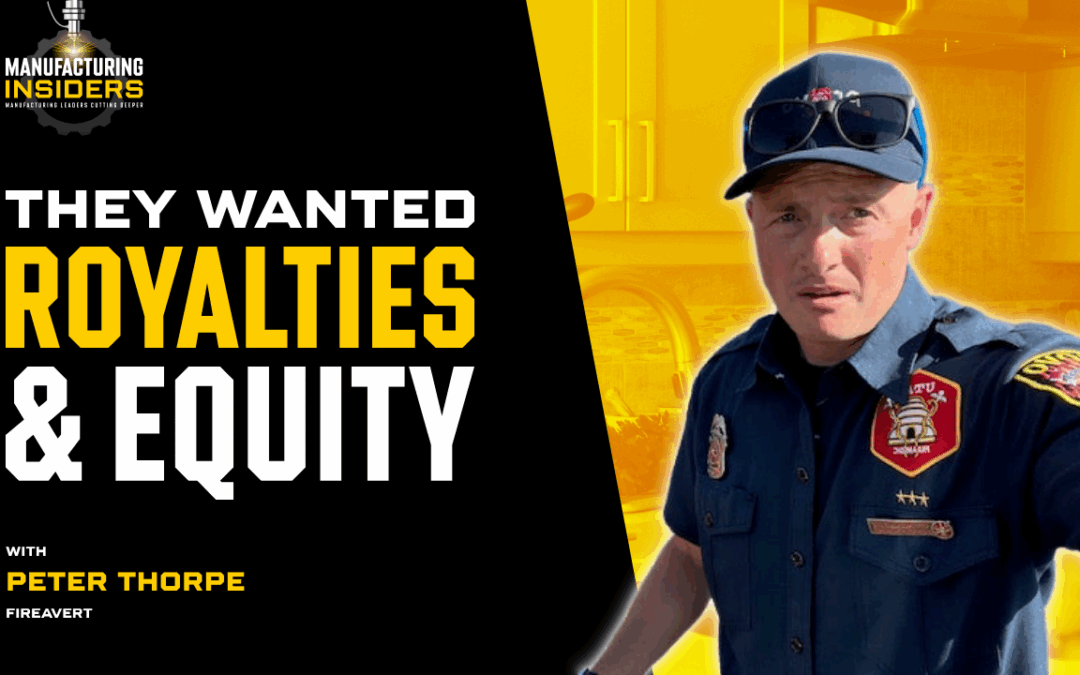
Peter Thorpe is an entrepreneur and an 18-year veteran firefighter. He is the founder of Fire Avert, a company that created a device to prevent kitchen fires. Thorpe took his product from concept to mass production while maintaining his full-time career. In this episode of Manufacturing Insiders, Peter breaks down the process of turning an idea into a physical product sold nationwide. He shares the story behind his invention, including the initial design challenges and the strategies used to scale production. He also breaks down the tariff impact on his production. His experience and lessons learned provide a clear roadmap for aspiring hardware entrepreneurs.
Thorpe shares his experience with design for manufacturability, highlighting the disconnect between third-party engineering firms and the factory floor. He explains his approach to overseas production, managing tooling costs as a startup, and the marketing pivot that led to widespread adoption. The discussion also provides a timely look at how his company is adapting its supply chain to overcome recent international tariffs.
Nate Wheeler is the host of the popular Manufacturing Insiders podcast. He also owns weCreate, a nationally recognized marketing agency that helps manufacturers grow, save money, and become more efficient.
10 key takeaways from the episode
1. Start Product Development by Solving a Real Problem
FireAvert began when firefighter Peter Thorpe noticed how often fire crews responded to kitchen smoke caused by food left on the stove. That recurring problem inspired a device designed to shut off the stove when it detects a smoke alarm.
2. Involve Your Manufacturer Early in the Design Process
Peter’s first engineering firm produced a design that the manufacturer couldn’t build efficiently. The factory redesigned it in a week, rather than the three months spent on the original design. The experience highlights the value of design for manufacturability (DFM) and collaboration between engineers and manufacturers.
3. Understand Tooling Costs and Ownership Before Production
New manufacturers need to understand how tooling expenses are paid, whether those costs are built into unit prices, and who owns the tooling. Peter explains why spreading tooling costs across production can help a young business conserve cash, while upfront ownership may be preferable for larger production volumes.
4. Getting a Product to Market Requires More Than a Good Idea
Peter built a team, competed in entrepreneurial competitions, and secured early funding before bringing FireAvert to market. His experience shows how product commercialization requires engineering, funding, manufacturing partnerships, and persistence.
5. Product Reliability Depends on Testing and Iteration
Early versions of FireAvert sometimes responded to unrelated sounds. The company collected thousands of potentially triggering sounds and invested in redesigning its electronics and firmware. Peter’s story demonstrates why product development must include rigorous testing, troubleshooting, and continuous improvement.
6. A Major Marketing Opportunity Can Come From the Right Story
FireAvert’s appearance on Shark Tank generated a dramatic surge in website traffic and sales, along with lasting credibility at trade shows. Although the investment deal ultimately did not close, the exposure helped propel the company forward.
7. The Tariff Impact on Production Can Force Manufacturers to Rethink Their Supply Chains
Peter describes how the FireAvert response to tariff uncertainty as equally haphazard. They were forced to abandon a shipment at port that landed right as the 100%+ tariff hit. From there they were forced to pause some shipments and explore alternative manufacturing locations, including Vietnam and other countries. And while they also began evaluating domestic production options, they could never justify the trade-offs between cost, sourcing flexibility, and supply-chain resilience. This demonstrates that while the tariff impact on production did make people consider supply chain reorganization: it still could not justify bringing production back to America. This demonstrates something very fundamental about economics, there is never just one factor that will solve all of your problems. Where manufacturers build factories is a multi-varied equation. If we want to see real change in global supply chains, there needs to be a combination of targeted incentives, not haphazard universal tariffs.
8. Domestic Manufacturing Must Compete on Cost and Capability
Peter would prefer to manufacture FireAvert in the United States, but explains that domestic production would substantially increase its price. the tariff impacts on production for him were all negative. , The company is exploring US assembly and equipment investments while comparing supplier quotes. The discussion highlights the challenge of bringing manufacturing back without losing competitiveness.
9. B2B Trade Shows Can Outperform Online Sales for Complex Products
FireAvert has struggled to make its website a major direct-sales channel, despite investing heavily in marketing. Instead, trade shows and consistent follow-up help the company reach multifamily property owners who can purchase hundreds or thousands of units. The lesson is to match the sales strategy to the customer and buying process.
10. Manufacturing Websites Should Target Buyers With Specific Problems
Nate explains that effective SEO content should align with what a prospective customer actually searches for. For FireAvert, content focused on preventing kitchen fires is more relevant than loosely related articles about fire safety. Peter’s goal is to make the website outperform individual sales representatives by attracting qualified buyers and communicating the product’s value.